Wildfire Recovery at The Niobrara Valley Preserve – Spring Green Up

Spring is finally changing the color of The Nature Conservancy’s Niobrara Valley Preserve in north central Nebraska.  After last summer’s wildfire and drought, much of the Preserve was barren and brown all winter.   Now, the area has had several small rainfalls during the last couple months, followed by a hard 3 inch rain on May 19.  That moisture has combined with the (finally) warming temperatures, and the Preserve is starting to look green again.  I traveled up to the Niobrara last week and took some photos to share with those of you who are interested in the site’s recovery.

The headquarters of the Niobrara Valley Preserve with sandhills prairie behind.  If it wasn't for the ponderosa pine skeletons in the foreground, it would be difficult to know that a major wildfire had occurred last summer.

The headquarters of the Niobrara Valley Preserve with sandhills prairie behind. If it wasn’t for the ponderosa pine skeletons in the foreground, it would be difficult to know that a major wildfire had occurred last summer.

.

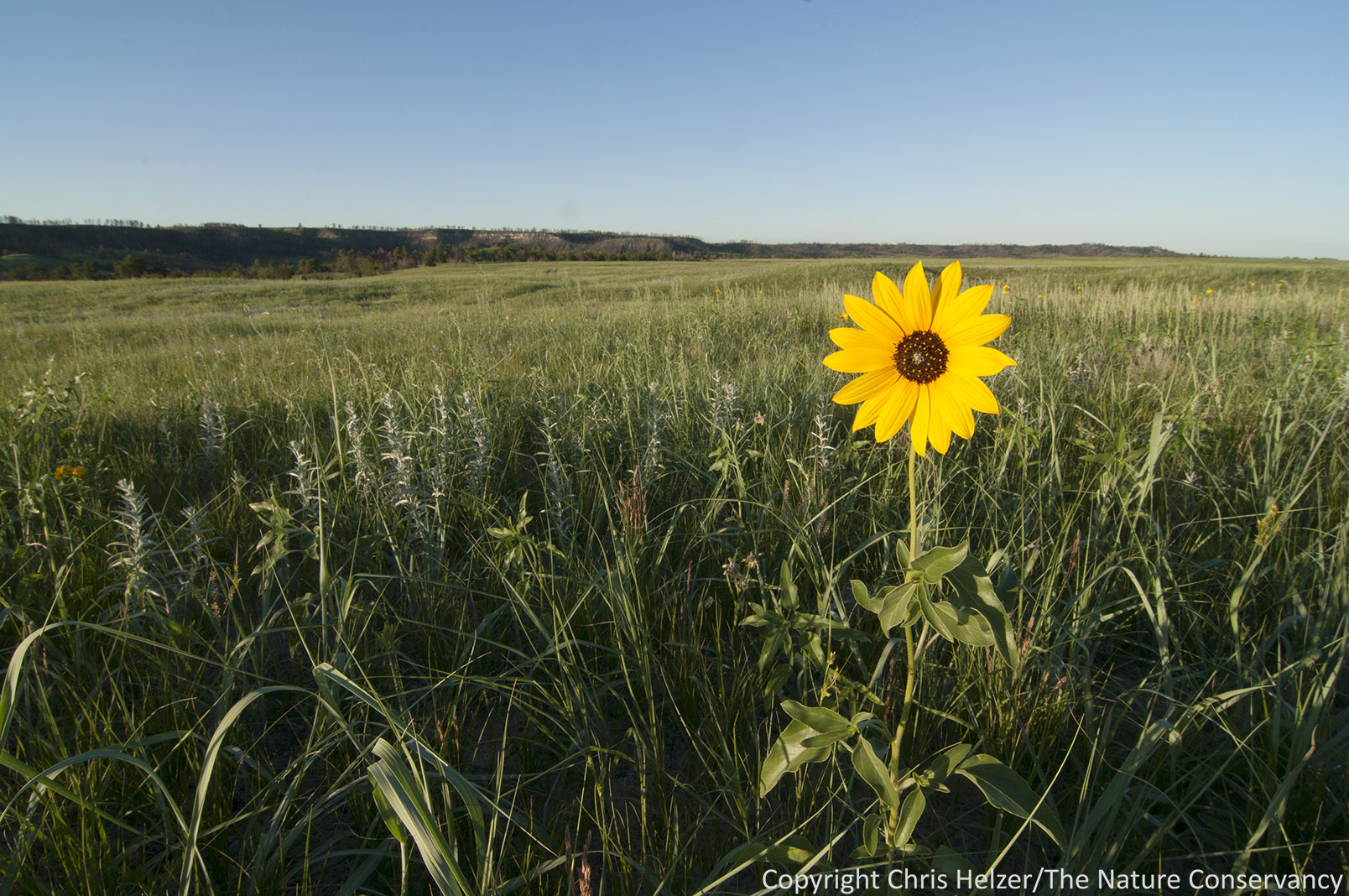
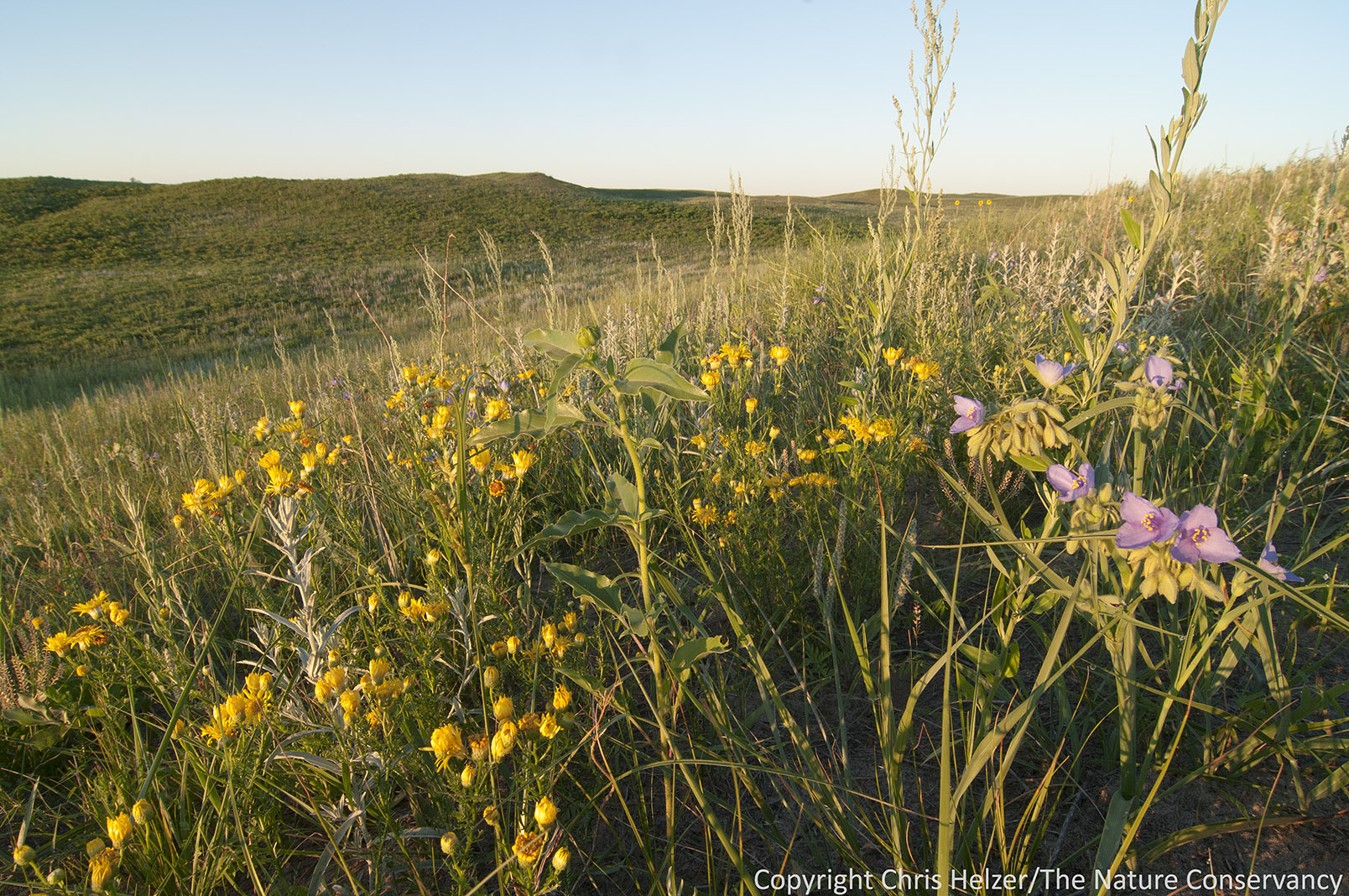
The sandhills prairie - as expected - is greening up very nicely.  Many wildflowers are blooming, including this hoary vetchling (aka peavine or Lathyrus polymorphus).

The prairie in the sandhills – as expected – is greening up very nicely. Many wildflowers are blooming, including this hoary vetchling (aka peavine or Lathyrus polymorphus).

.

The recent big rain washed much of the remaining ash off the slopes north of the river.  At the bottom of this photo, you can see the accumulation of the black goo that washed down.  It was thick enough in some places that the road was closed when I was there last week.

The recent big rain washed much of the remaining ash off the slopes north of the river. At the bottom of this photo, you can see the accumulation of the black goo that washed down. It was thick enough in some places that the road was closed while I was there last week.

One of the things we’ve been watching for and wondering about is soil erosion on the barren slopes – especially underneath formerly dense stands of pines and/or cedar trees.  When I arrived at the preserve, several days after the big rain, the road along the river was closed because of an accumulation of black goo that had washed off the slopes above it.  It was hard to tell, but it appeared to be mostly ash, mixed with some organic matter.  Seeing that on the road, I was worried about what I’d find when I climbed the slopes.

A closer look at the black goo, seen here in a low pocket further up slope.

A closer look at the black goo, seen here in a low pocket further up slope.

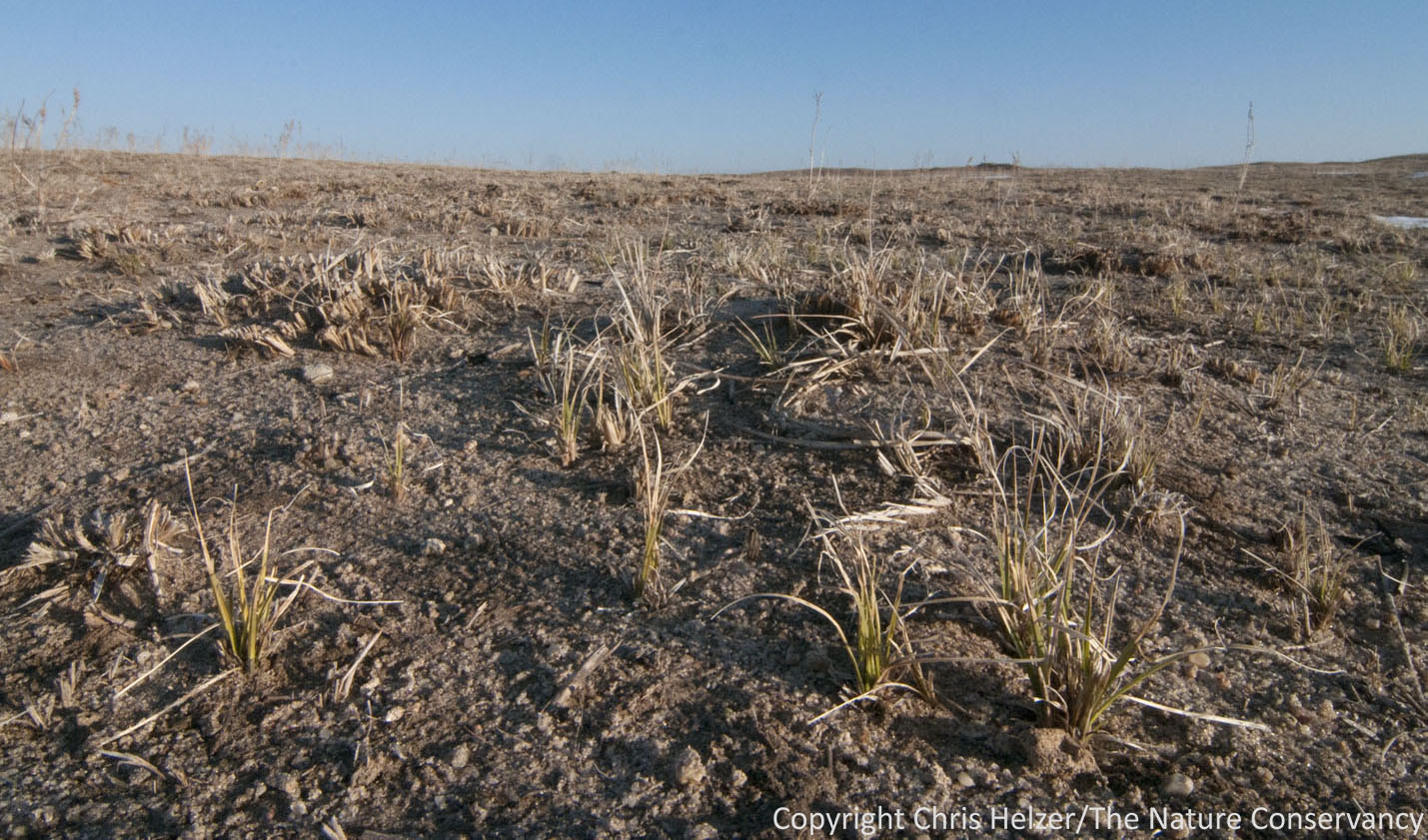
However, as I climbed the ridge north of the river, I was pleasantly surprised.  There was some soil erosion, but much less than I’d expected.  Green plants were popping up across the ridges, forming thicker carpets in areas where tree density had been lower.

Green plants dot the upper slopes, especially in places where pines and cedars grew less densely.

Green plants dot the upper slopes, especially in places where pines and cedars grew less densely.

.

Annuals are abundant, including this

Annuals were abundant, including this Chenopodium species.

Many of the green plants were “weedy” annuals, taking advantage of the sudden lack of competition for light and moisture.  However, numerous perennials were growing too – including leadplant, puccoons, skeleton weed, peavine, several species of grasses and sedges, and many more.

Perennial plants

Perennial plants and shrubs were mixed in with the annuals.  A the lower left of this photo is skunkbush sumac.  Perennial grasses can be seen in the background.

.

As bad as it got.

This was about as bad as it got for soil erosion on the steep slopes, and I had to look for a while to find many examples like this.  Rather than large scale slides or obvious losses of top soil, multiple rivulets formed in many places.  In between the rivulets, however, perennial and annual plants were growing and helping to stabilize the remaining soil.  The lightest colored steep bluffs are mostly devoid of soil, but were like that prior to the fire rather than as a response to it.

.

Erosion pins

We have erosion pins in a number of places to help measure soil loss.  The pins were installed in December and are being measured right now to see how much soil we’ve lost.  The arrays of pins are located on a range of site types, varying in slope, aspect, and vegetation type.  Additional erosion pin arrays will be installed in the coming weeks.

.

Regrowth

Most oak trees were resprouting from their bases.  Oaks that had been burned less intensely hadn’t started their spring growth at all this year, so it’s still unknown whether some of those will be able to continue growing from the ends of their branches.  Unburned oaks were leafing out, so we should see something from the “lightly” burned ones in the next couple of weeks.

.

For better or worse, deer tracks were common.

For better or worse, deer tracks were common.  Some of the oak resprouts were clearly being nipped back by deer and/or other wildlife, as were sedges and other green plants.

I don’t know what the future will hold for the Preserve, but I’m still optimistic.  The sandhills and other prairies will clearly be fine.  The woodlands will be slow to recover, but there are positive signs already.  It’s hard to know how much erosion will occur or important that is.  So far, even the most vulnerable slopes seem more resistant to erosion than I’d guessed they would be.  Regardless, the Preserve is recovering, and will continue to be a beautiful place and important biological resource.  And it’ll be very interesting to watch!

Other than steep slopes conifers were dense, the green up is well underway.

Other than steep slopes where conifers were dense, the green up is well underway.

Keeping a Low Profile in the Spring

At times, prairies in east-central Nebraska can have such an abundance of large wildflowers, they resemble flower gardens.  Early spring is not one of those times.  There are plenty of prairie flowers blooming this spring, but you wouldn’t know it from a distance.  In fact, it often seems as if you have to nearly step on a spring wildflower before you see it.

These ground plum flowers, while very pretty, look like they're alone in a vast barren landscape.

These blooming ground plum plant, while very pretty, looks like its alone in a vast barren landscape.  In reality, there are lots of other flowers on the prairie – they’re just hard to see.  This photo was taken last week at Prairie Plains Resource Institute’s Griffith Prairie.

In the coming weeks, things will change.  Late spring and early summer flowers such as ragwort (Senecio plattensis), shell-leaf penstemon (Penstemon grandiflorus) and spiderworts (Tradescantia spp) will be displayed at the top of stems that rise a foot or two from the ground.   Clusters of those flowers can easily be seen from hundreds of yards away.  For now, however, wildflowers are keeping a low profile.

Of course, short stature and small flowers make perfect sense in the early spring.  Flowers that bloom at the beginning of the growing season don’t have much time between winter’s thaw and blooming time (especially this year!)  The small plants are in a race to bloom before neighbors – especially grasses – overtop them, making it difficult for both pollinators and light to find them.   For the most part, spring-flowering plants grow just long enough stems to get their flowers off the ground and make those flowers just big enough to attract pollinating insects.

Wind flower (Anemone caroliniana) blooms at heights of about 3 or 4 inches.  Because both the flowers and stems are small, even a big patch of wind flowers can be difficult to see from 15-20 feet away.  Photo taken at Prairie Plains Resource Insitute's Griffith Prairie.

Wind flower (Anemone caroliniana) blooms at heights of about 3 or 4 inches. Because both the flowers and stems are small, even a big patch of wind flowers can be difficult to see from 15-20 feet away.

While not universally true, many early flowering plants seem to thrive best when a prairie isn’t loaded with thatch and tall dead vegetation from previous seasons.  Prairies burned during the dormant season or were grazed or hayed the previous summer/fall seem to have the greatest abundance of spring flowers.  Of course, there is some observer bias involved in measuring that since spring flowers are much easier to see in short vegetation…

Wild pansy, aka Johnny Jump-up (Viola rafinesquii), is an annual violet that is spreading (in a good way) across some of our restored Platte River Prairies.  It is flourishing this spring in sites that were grazed during last year's drought.

Wild pansy, aka Johnny Jump-up (Viola rafinesquii), is an annual violet that is spreading (in a good way) across some of our restored Platte River Prairies. It is flourishing this spring in sites that were grazed during last year’s drought.

.

Many narrowleaf puccoon (Lithospermum incisum) plants are blooming at even shorter heights than usual this spring.  While never a tall plant, narrowleaf puccoon often reaches heights of 6-10 inches or so, but this year, many are blooming at 4-6 inches in height.

Many narrowleaf puccoon (Lithospermum incisum) plants are blooming at even shorter heights than usual this spring. While never a tall plant, narrowleaf puccoon often reaches heights of 6-10 inches or so, but this year, many are blooming at 4-6 inches in height.

This spring, I’ve been paying particular attention to prairies that we burned and grazed during drought of 2012.  Most were awfully short, brown, and barren-looking by late last summer and stayed that way through the winter.  It’s been nice to see them greening up this spring and supporting good numbers of wildflowers.  Interestingly, I’ve seen more wind flowers (Anemone caroliniana) this year than I can remember from previous springs.  The two sites in which I’ve seen big patches of wind flowers were both burned and grazed pretty hard last year, making the flowers easy to see, but probably also allowing the plants to grow with little competition for light or other resources.

While spring flowers are short in stature, they seem to be able to attract pollinators.  Of course, many of those pollinators are good at finding hidden plants by following their scent.  In addition, when the number of flowering species is limited, pollinators do what it takes to find whatever flowers are available!

What’s more interesting to me is that as I’ve been seeing and photographing wind flowers over the last week or so, I’ve seen a surprising number of tiny crab spiders on them.  I would guess that there’s a crab spider on one out of every 10-15 flowers, and they all appear (to me) to be of the same species.  I wish I knew how those crab spiders found the flowers.

A crab spider sits on a wind flower on an early morning at Griffith prairie, waiting for the flower to open and attract pollinators for it to catch.

A crab spider sits on a wind flower at Griffith prairie in the early morning, waiting for the flower to open and attract pollinators for it to catch.

.

XX miles away from Griffith Prairie, this crab spider (of the same species?) was having a successful afternoon of hunting in our Platte River Prairies.

45 miles away from Griffith Prairie, this crab spider (of the same species?) was having a successful afternoon of hunting on a wind flower in our Platte River Prairies.

I’ve been seeing a lot of trailing silks in the air lately, so I know some spiders are on the move (by ballooning), and I assume young crab spiders disperse that way.  But if they do, landing on or near a flowering plant at this time of year seems awfully unlikely.  Are the crab spiders I’m seeing on wind flowers the lucky few that landed near a good hunting place?  Or are most crab spiders able to find a flower to hunt on, even in the spring when flowers are scattered around in low numbers?  If so, how?

Maybe one of you will be able to answer those questions for me.  For now, I’ll just add them to my long list of other questions – a list that will surely grow considerably during this coming field season.