
Conservation Photography in the Digital Age

Conservation photographers play a critical role in world of conservation.  They combine nature photography, photojournalism, and advocacy to draw the public’s attention to the most critical environmental issues in today’s world.  Unfortunately, it’s getting harder for conservation photographers to make a living.  That could have serious consequences, especially in light of the growing urbanization of the general public.

Conservation photography can be a lonely profession, but plays a critical role in conservation.  Ty Smedes at The Nature Conservancy's Broken Kettle Grasslands - Northwest Iowa.

Conservation photography can be a lonely profession, but plays a critical role in conservation. Ty Smedes at The Nature Conservancy’s Broken Kettle Grasslands – Northwest Iowa.

In some ways, photography is getting easier, and it’s certainly accessible to more people than it used to be.  Today’s cheap digital cameras have many features that, just a few decades ago, were found only on very expensive high end cameras.  As a result, novice photographers can often capture great photos from situations that used to flummox the most veteran of photographers.  In addition, of course, nearly everyone carries a camera with them, nowadays – most often in their phone – so being in the right place at the right time (with a camera) is a much more common occurrence than it used to be. 
Continue reading

Lessons From a Project to Improve Prairie Quality – Part 1: Patch-Burn Grazing, Plant Diversity, and Butterflies

We recently completed a large multi-year restoration and management project at our Platte River Prairies.  Our specific objectives were to improve habitat quality for various at-risk prairie species and evaluate the impacts of our management on at-risk butterflies – particularly regal fritillaries.  The project was supported by the Nebraska Game and Parks Commission, who funded our work with two State Wildlife Grants (U.S. Fish and Wildlife Service money).  Over five years, we conducted fire/grazing management in our prairies and enhanced plant diversity through overseeding and seedling plugs.  We measured the results of that work by measuring changes in prairie plant communities and by looking at the use of our prairies by regal fritillaries and other butterflies.

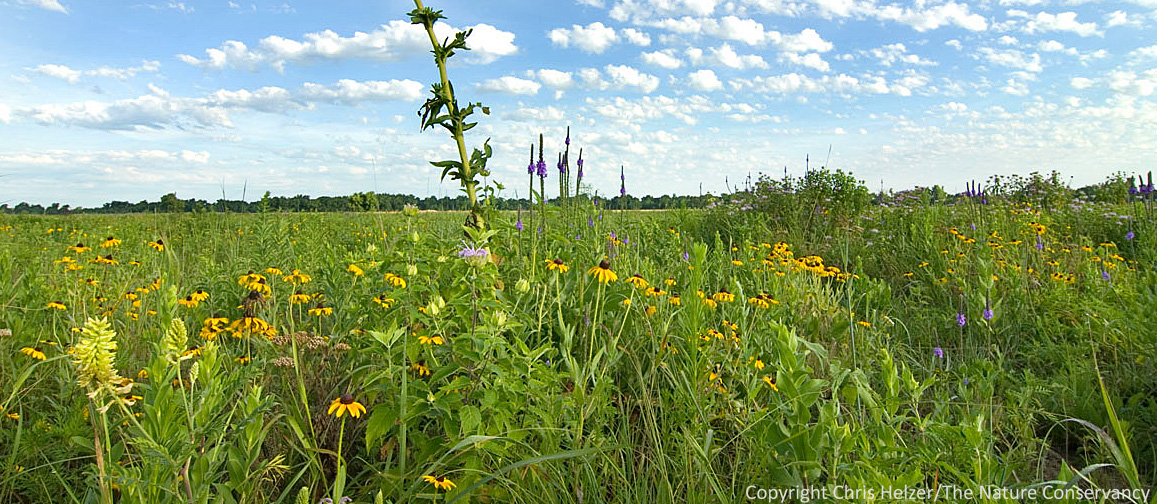
Plant diversity and buttterfly habitat were the objectives of our 5-year project.

We’ve worked hard to get plant diversity in our restored prairies, including this one.  We wanted to know whether or not our management was maintaining that diversity, and also how it was affecting butterflies.  The prairie shown here was being grazed at the time of the photo – July 2009.  The Nature Conservancy’s Platte River Prairies, Nebraska.

The following is a brief summary of the major lessons we’ve gleaned from the fire/grazing component of the project, including implications for future management and restoration work.  I will summarize the overseeding/seedling work in a separate upcoming post.  If you want more details, you can see our entire final report to the funding agencies here.  As a warning, the report is 14 pages long, with an additional 21 pages of Appendices, full of tables and graphs.

What We Did
Between 2008 and 2012, we treated over 1,500 acres of prairie with varying applications of patch-burn grazing management.  During that time, we altered the timing of burning and the intensity of grazing from year to year, and included years of complete rest from grazing in some prairies.  For the purposes of this project, we evaluated the results of our work in two main ways:

–          We measured changes in plant diversity and mean floristic quality.

–          We conducted three years of butterfly surveys to evaluate how regal fritillaries and other butterfly species responded to our restoration and management work.

Continue reading