Konza Prairie Trip Part 2 – Tree and Shrub Encroachment

A couple years ago, I wrote about some work from Kansas State University related to woody plant expansion in prairies.  Many of us who work with prairies constantly wrestle with questions about trees in prairies. Why are they encroaching so quickly these days? What prevented them from doing that in the past?  During our recent trip to Konza Prairie, we got to discuss this topic more in-depth with Jesse Nippert and other researchers at Kansas State.

Clearly, a combination of factors influences how quickly trees and shrubs enter and spread in grasslands.  One big reason is the increase in “seed rain” in some of today’s prairies.  Prairies in fragmented landscapes with numerous trees and shrubs in nearby woodlots, road ditches, shelterbelts, etc., are deluged with seeds from those woody plants.  The vast majority of those seeds fail to establish, but the high number of seeds coming in means that some will find opportunities to grow.

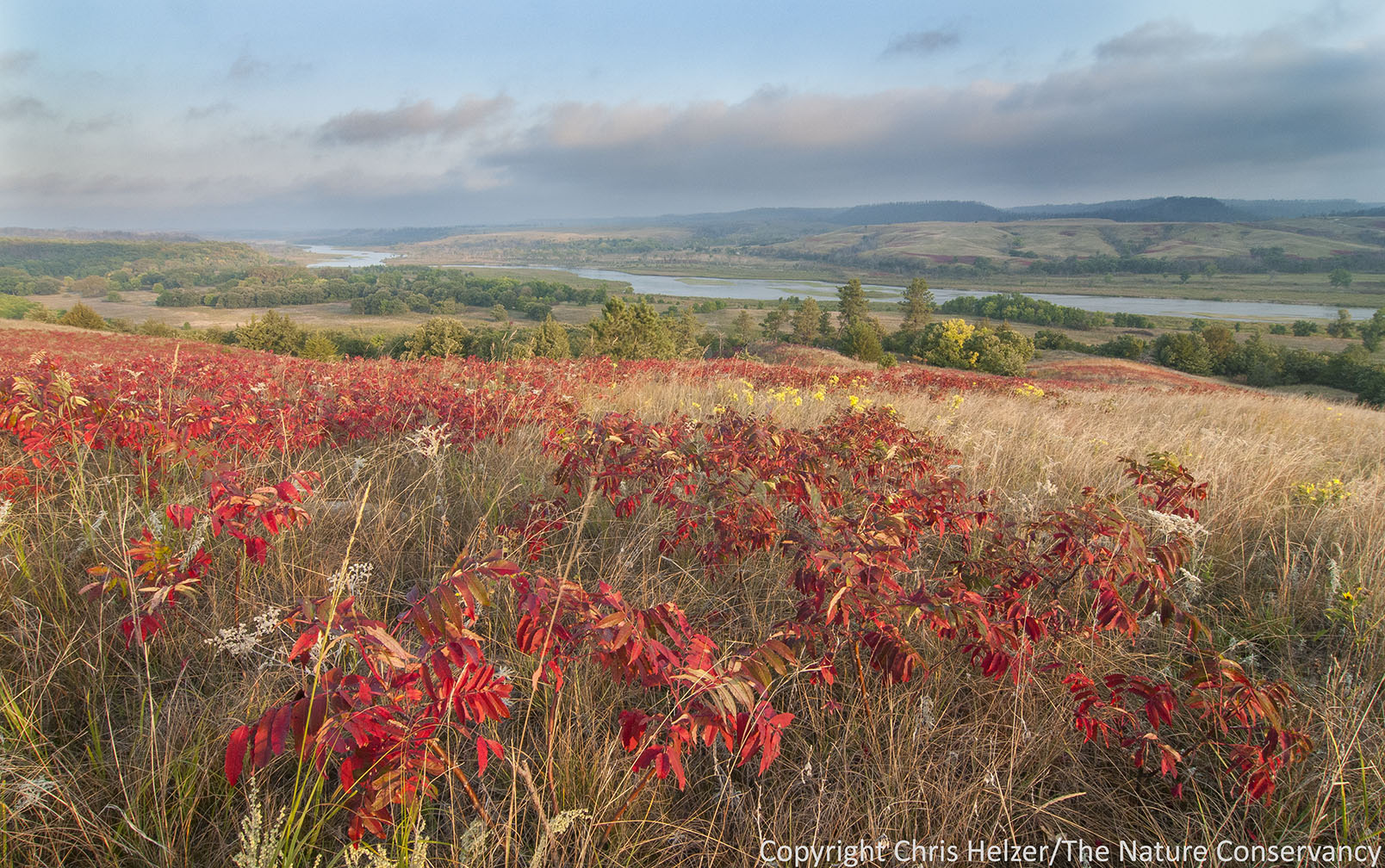
Smooth sumac clones like this small one are expanding at Konza Prairie, especially in areas burned less frequently than every other year.

Smooth sumac clones like this small one are expanding at Konza Prairie and many other sites in central North America.

Other factors may include the higher rates of carbon dioxide in today’s atmosphere and higher amounts of nitrogen deposition (from industry and agricultural facilities, for example), both of which tend to favor woody plant establishment.  In addition, we are in a relatively wet climatic period if you look at the geologic record.  While there have been droughts, including severe ones, in recent years, those droughts are nothing like the multi-decade severe droughts that can be seen in the relatively recent geologic records for the central United States.  Long and/or frequent droughts favor herbaceous plants (such as grasses and wildflowers) over trees.

However, Jesse Nippert’s research into the way trees, shrubs, grasses, and forbs (wildflowers) compete for water belowground provides some additional insight into the march of woody plants into prairies.  As we started talking about roots, Jesse confirmed something I’d heard from Dave Wedin at the University of Nebraska; even though grasses can have very deep roots, most of their water use is actually very shallow – within the top 25 cm of soil.  Jesse says the reason those grasses persist during very dry periods is not because of their deep root systems, but because they can continue to grow and function when available soil moisture is very low.  Forbs also pull a lot of their moisture from shallow roots, but utilize slightly deeper roots (50-75 cm deep) during droughts because they can’t compete well with the ultra-efficient fine-rooted grasses at the upper levels.

It turns out that understanding root competition might help us better understand woody plant encroachment as well.  In many parts of Konza prairie, clonal shrubs such as rough-leaved dogwood and smooth sumac have expanded rapidly over the last several decades.  As Jesse and his students have studied this phenomenon, they have concluded that an important factor behind this expansion is the strategy those shrub clones use to acquire water.  While grasses and forbs are mostly using water from the top 1/2m of the soil, shrubs pull much of their water from deeper in the soil profile, allowing them critical access to water not being utilized by their competition – especially in years when the upper soil layers are dry.

The clonal form of dogwood and sumac gives them another advantage.  As clones expand, the tillers (aboveground stems) on the outer edge of the clones have very small roots.  However, by studying the isotopic signatures of the water in those shallow-rooted tillers, Jesse can tell that they are also accessing water from deep in the soil profile.  He says this is almost surely because the older, deep-rooted plants in the center of the clone are sharing the water they acquire with the younger stems on the outside.  Not a bad strategy.

Of course, as these clones of dogwood and sumac use their water acquisition and sharing strategy to advantage and spread into the prairie, they also shade out their competition – especially beneath the tall/dense tillers toward the centers of clones.  Suppressing the growth of grassy undergrowth not only removes that competition for resources, it also helps make the clones fireproof.  Since dried grasses are the primary fuel for prairie fires, the absence of grasses beneath shrub clones means that fires can’t burn through them.  It’s not hard to see how the processes of deep water acquisition/sharing and fire-proofing can create a positive feedback loop that helps drive an inexorable expansion of shrubs into the surrounding prairie.

We didn’t talk about this in Kansas, but my experience is that fire-proof shrub clones are an important avenue for the establishment of trees as well.  Many tree seeds are deposited into those shrub patches by birds that see those shrubs as convenient and prominent perching sites.  If those seeds are able to germinate and establish within those clones – and they often can – the resulting trees can grow without fear of the fires that would otherwise threaten them.  Hiding in the middle of big shrub clones also gives those trees a chance to grow in relative safety from marauding prairie land managers…

Because much of Konza prairie has been managed under a variety of long-term fire regimes (1,2,4,10, and 20 year frequencies), Kansas State Researchers have some pretty good data on how fire frequency affects shrub expansion as well.  Essentially, prairies burned every year or every other year do not have encroachment by dogwood or sumac, but prairies burned less often are being gradually overtaken by shrubs.  Interestingly, the fastest expansion appears to be in prairie watersheds managed with a fire frequency of every four years (which is also about what the estimated average fire frequency was for that landscape during pre-European settlement).  While it might seem counterintuitive that a four year fire frequency allows for faster woody encroachment than a 10 or 20 year frequency, the explanation appears to lie in the way shrubs respond to fire.  Fire seems to stimulate radial growth in dogwood and sumac, meaning that the plants put an emphasis in growing horizontally rather than just vertically after they are burned.  Under very frequent fire, this is apparently immaterial, probably because the shrubs never get enough rest between fires to take advantage of that radial growth.  However, when they are given 3 years to recover between fires, that radial growth response after each fire means that burning actually stimulates faster expansion of shrub clones.  Under a 10 year fire frequency, that extra radial growth only occurs once every 10 years, so the overall expansion is actually slower than in under a four year fire regime.

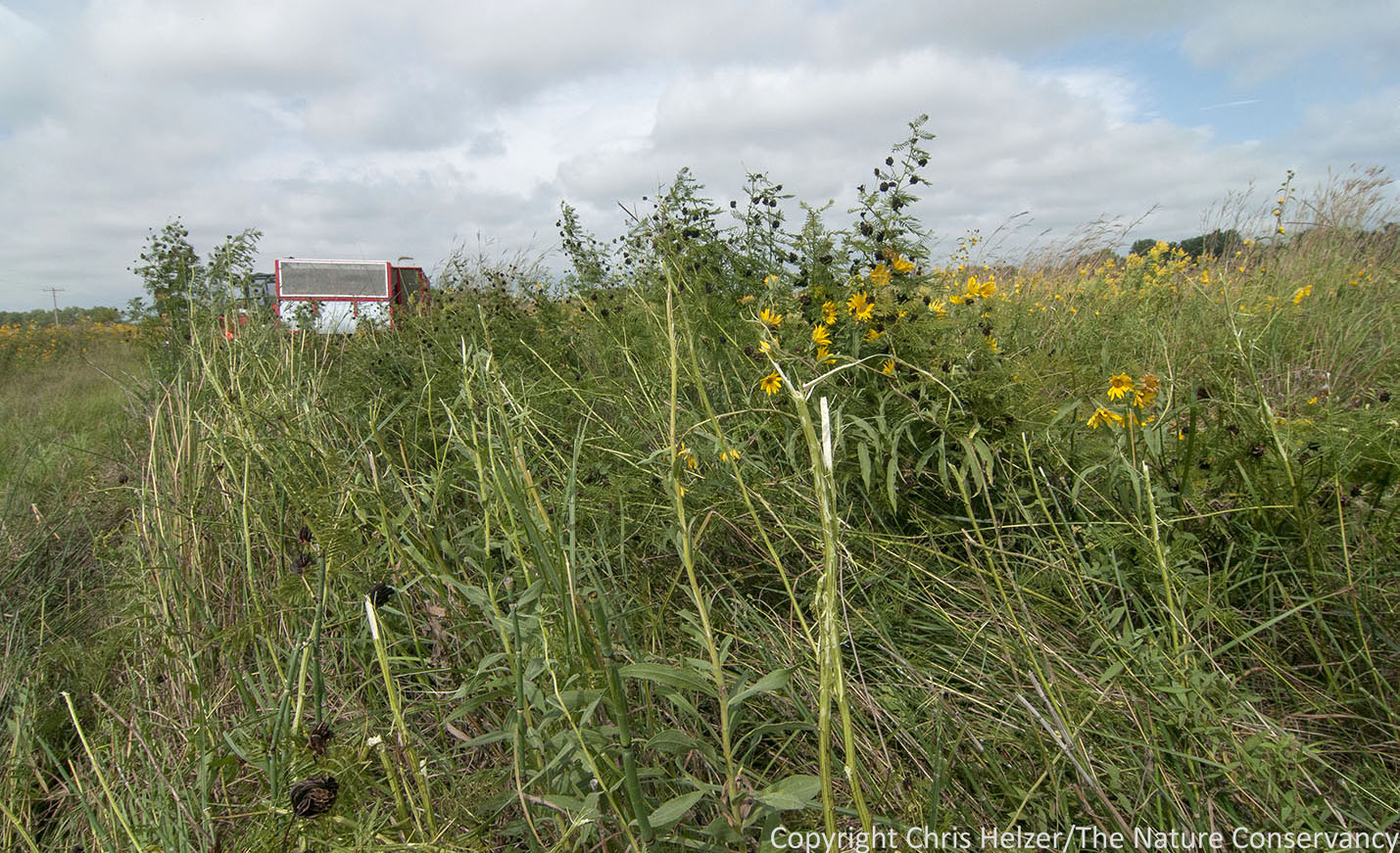
Small research plots like these at Konza Prairie help demonstrate the impacts of various fire frequencies.  The treeless grassland to the left is burned annually.  The wooded area to the right is burned every 20 years.  Both started out looking the same.

Small research plots like these at Konza Prairie help demonstrate the impacts of various fire frequencies. The treeless grassland to the left is burned annually. The wooded area to the right is burned every 20 years. Both started out looking the same.

Before you jump to the conclusion that burning every year or two seems the obvious best strategy for shrub control, remember that woody plant suppression is only one of many objectives for prairie management.  I’ll address some of the other, less positive, effects of frequent fires at Konza in an upcoming post.

As I said earlier, there are multiple factors that affect the rate of tree and shrub encroachment on prairies.  Seed rain might be as important as anything, and climatic conditions, increases in nitrogen and carbon dioxide levels, and fire suppression are all likely contributors as well.  However, the way plants compete belowground, particularly the deep water use strategy of clonal shrubs such as dogwood and sumac, also seems to play an important role.   Frequent fire application can be one way to prevent encroachment, though it comes with other baggage (see upcoming post…) and may not help remove shrub patches once they’re established.  At Konza, they took some of the every-20-year-fire-freuency watersheds and started burning them annually to see if they could get rid of the shrubs and trees.  Thirteen years later, those patches are still there, though the individual stems are much smaller.  It seems that while frequent fire might help prevent woody plant establishment, frequent fire alone might not be able to reverse it – at least not on a very fast timeline.

Woody plant encroachment is one of the biggest challenges we face in prairie management today.  A solid understanding of the mechanisms behind that encroachment should help us design more effective strategies to combat it.  Shredding, burning and herbicide application are all useful tactics, but figuring out the timing, frequency, and intensity of those applications will be critical.  We need to use the various competitive strategies of grasses, forbs, and shrubs to our advantage.  As an example, some recent work by Dirac Twidwell (University of Nebraska-Lincoln) seems to indicate that burning under more extreme heat and drought conditions than we typically feel comfortable with might be one way to really tip the scales away from woody plants.  The feasibility of that will be limited in some landscapes, but surely there are other innovative tactics that can help.  If we work together and aren’t afraid to try some new ideas, we can figure this out.


The Hidden Depths of Kim Tri

When Kim Tri (pronounced “tree) contacted us about coming out to volunteer for a month in the late spring/early summer, we weren’t sure what to think.  Why would someone from Sterling College in Vermont – a tiny little liberal arts school we’d never heard of – want to come spend a month learning about prairies and doing land stewardship work?  She said she needed to do a senior project for school which would entail keeping a journal while she was here and then producing a mural (?!) as a final product.  Hmm…

However, as we looked into her a little more, we felt a little more comfortable.  She had grown up in Rochester, Minnesota and had spent a couple years doing Conservation Corps work around the country, so she at least had some familiarity with prairies and hard work.  Plus, we weren’t in a position to be too picky – we really needed the help.  …We got back to her and said we’d be happy to host her for a month.

When Kim arrived, we were in the midst of an herbicide spraying campaign against both musk thistles and poison hemlock.  She jumped right into the fray, joined the crew, and was a huge help.  Besides being a quick study and hard worker, we also learned that Kim was an artist of considerable skill.  She showed us some of her sketches and paintings one afternoon, and it was clear she knew what she was doing.   The mural idea started to make a little more sense, though I was really curious to see what she would come up with.  Before Kim left us, I asked her to send me a photo of the mural when she finished it, and said that maybe between some of her journal writing and the mural, we could make a blog post of some kind about her experience.  (I kept my expectations fairly low.)

Kim at the Niobrara Valley Preserve during a rare moment of leisure.

Kim at the Niobrara Valley Preserve during a rare moment of leisure.

Last week, Kim sent me a photo of the mural (see below) along with a complete – and excellent -blog post, already written and ready to go.  She even had some very nice photos to illustrate the post.  I think you’ll appreciate her talents as you read her essay and enjoy her photographs and mural.  I’m going to get out of the way now and let you do that.

All the writing and artwork below are by Kim.

            The announcement that I had plans in Nebraska was treated with a sort of pitying disbelief, expressed in one word.  “Why?” I brushed this off, steering more than one of these conversations around with an inspiration drawn from the cause for which I was prepared to travel a thousand miles and back.

            Earlier this year, my answer to a similar question was much different.  I recall mentioning the idea of spending time in Nebraska or Kansas.  That time had to be spent somewhere with prairies and the folks who conserve them, according to the proposal I’d written for my senior project.  Why Nebraska or Kansas?  “Because I hate them so much,” I’d laugh.

            Let me first say that I didn’t really mean that.  Every state has its charms.  The real reason, which I was reluctant to articulate, was to challenge myself.  It was crucial, personally, to prove that prairies were as dear to me as I felt they were when I was rambling around the Green Mountains.  Would I feel the same in the midst of a state for which I held no affection?

            Really, I only personally disliked Kansas.  For me, Kansas was long, flat hours in the long, flat dark, a long, long way from anywhere called home.

            Nebraska, in my only experience of the state, was a snowstorm following me from Arizona.  It was blurry stretches of highways that had to be travelled in order to make it back to Minnesota.  Also, I remember red noses stuck on the deer crossing signs, but that’s beside the point.

            My attitude towards Nebraska came from a friend who had logged a lot of hours travelling through the state and was convinced that the country would be better off without it.  This friend visited me at the Platte River Prairies on his way across the interstate.  One spectacular sunset and an evening in the Sandhills later, he turned to me where we sat on the shag carpet of the legendary Derr House.  “So this is school for you?” he said.  “I guess you’ve got it figured out.”

            Yup, I’d say so.

Blooming prickly pear cactus along the Platte River in Nebraska.  Photo by Kim Tri.

Blooming prickly pear cactus along the Platte River in Nebraska. Photo by Kim Tri.

            Before arriving at the Platte River Prairies, the place for me was mostly a blank.  Having briefly looked over this blog while studying, I half-remembered having seen the preserve through the lens of another’s camera, but all I really had was a dot on a map.  Of all of the handy volunteer pages for the various Plains states on The Nature Conservancy website, theirs was the best put together.  It offered housing to scholarly volunteers who were interested in a month or so of work.  Decision made.

            I blew into the preserve on the harsh wind of a Plains thunderstorm, which gave way to a long, rainy day in which to think about what I’d done.  I had no apprehensions about the house, but still I felt the niggling doubt that accompanies me on every move.  Where the heck was I?  Marooned in a vast island of corn, so different from the mountains of the past few years.  Also, it was rainy.

            Still, I had to explore—meet the neighbors, so to speak.  I first became acquainted with the little prickly pear in the yard, a reassuring sign of being back west.  Then I met the yellow spring flowers, the ragwort and puccoon—sunny faces on a gray day, particularly when the sun shone on them through the breaks in the clouds.  The sudden sunlight also illuminated the grazing cows, making them appear touched with grace.  The cattle were also neighbors, which I came to accept despite my lifelong dislike of cattle.  They are essential parts of the natural community in a grassland ecosystem evolved to grazing.

Prairie ragwort (Packera plattensis) - The Nature Conservancy's Platte River Prairies.  Photo by Kim Tri

Prairie ragwort (Packera plattensis) – The Nature Conservancy’s Platte River Prairies. Photo by Kim Tri

Cattle grazing along one of the hiking trails through the Platte River Prairies.  Photo by Kim Tri.

Cattle grazing along one of the hiking trails through the Platte River Prairies. Photo by Kim Tri.

           My doubt didn’t last long.  This vibrant little community of the prairie bustled with inhabitants.  Kingbirds flicked their tails, deer bounded away, hawks soared, owls called, waterfowl preened.  Insects buzzed and greeted the new blossoms.  I, too, greeted the opening flowers, alert for something new every day to write in the journal which I was tasked to keep of my time in Nebraska.  Now, as much as I appreciate Aldo Leopold, phenology had always seemed tedious.  Then, suddenly, I understood.  I was elated at the sight of the first blooming prairie coneflower.  Ever since learning to recognize it, I’d been eyeing its developing buds and waiting.

Yellow coneflower, aka upright prairie coneflower (Ratibida columnifera).  Photo by Kim Tri

Yellow coneflower, aka upright prairie coneflower (Ratibida columnifera). Photo by Kim Tri

            What I remember most is a sense of peace in the tall grass.  Back in Vermont, there was no end of inspiring landscapes, but the trees and hills were becoming stifling, making me restless.  Out on the prairie, it was different.  Studying the grasslands was not like studying the forests, in a way that’s difficult to describe.  Perhaps it’s the clarity of being able to see so far.  Perhaps it’s watching the mood of the sky for warning weather, the wild power of the thunderstorms that make all calm days seem extraordinarily tranquil.

            There was something also in my timing that seemed perfect, as well.  In my brief spell at the preserve, I got to experience the last burn of the season, straggling Sandhill cranes, the Niobrara preserve and their legendary bison tours, an unusually early Field Day, and a succession of wildflowers.

Colorful clouds over the prairie before sunrise.  Platte River Prairies. Photo by Kim Tri.

Colorful clouds over the prairie before sunrise. Platte River Prairies. Photo by Kim Tri.

            Perhaps it’s always the right time to be at the Platte River Prairies.  That would explain the chronic volunteers, who indulge their prairie work like a habit, and the revolving door of visiting researchers.  And everyone had something to teach, more than I could readily absorb.  Back in Vermont, a stack of books and an unreliable internet connection were my portal into the prairies.  Being in Nebraska, I was surrounded by dedicated and knowledgeable folks, and was frankly a little spoiled.  I’d gone from teaching my senior project advisor about drought and fire ecology to living it, being schooled by others and the land.

            In a long line of good life decisions, I can add this one to the list, for sure.

Mural by Kim Tri, inspired by her time in The Nature Conservancy's Platte River Prairies, Nebraska.

Mural by Kim Tri, inspired by her time in The Nature Conservancy’s Platte River Prairies, Nebraska.  Please click on the image to see a larger, sharper version.  It’s worth it.