
Note to my son (and others who mainly follow this blog to see if there are cool pictures or pictures of them): This is a pretty long and involved post – sorry. The first picture is probably the best one, though there are a couple other decent prairie photos further down (though none with you in them). The other pictures are more instructional than aesthetically pleasing. Don’t worry, I’ll put up some better photos later this week.
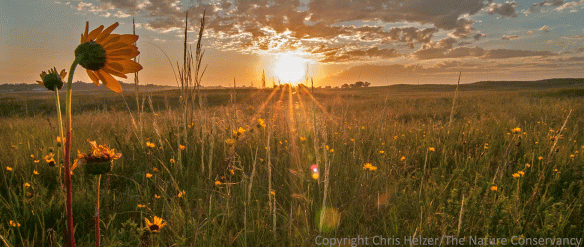
Restored sand prairie at The Nature Conservancy’s Platte River Prairies, Nebraska. This prairie was seeded in 2002 and has been managed with sporadic intensive grazing and fire.
Great Plains grasslands are more resilient than most of us give them credit for. Just recently, for example, they survived the drought of 2012, the worst single year drought on record in many places (including at our Platte River Prairies). In a post I wrote during 2012, I compared that drought to similar conditions described by famous prairie ecologist J.E. Weaver back in the 1934. In both cases, prairies recovered nicely. In fact, in a 1944 paper, Weaver and collaborator Frederick Alberts provided a detailed summary of how prairies in Iowa, Nebraska, and east-central Kansas persevered and recovered from repeated drought conditions between 1933 and 1943.
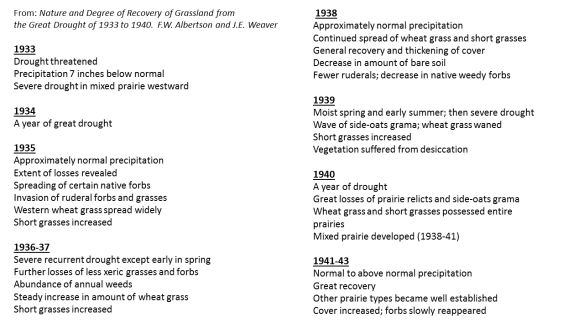
This brief summary was part of the 1944 paper referenced above that documented how prairies reacted to the drought years of the 1930’s. The paper is worth reading if you’re interested in how prairies might respond to droughts in the future. You can click on the image to make the print larger.
Nebraska prairies have also shown resilience to intensive fire and grazing – historically by bison and currently by cattle. Chronic overgrazing, of course, can decrease plant diversity and cause cascading negative impacts on prairie animals and critical ecological processes. However, most prairies can easily withstand periodic bouts of intensive grazing followed by comparable rest periods. We’ve been tracking plant community responses to this kind of fire/cattle grazing management in our Platte River Prairies since 2002 and have seen plant diversity remain stable. Even grazing-sensitive plants such as rosinweed (Silphium integrifolium), Canada milkvetch (Astragalus canadensis), prairie clovers (Dalea sp.) and others have maintained their populations. Likewise, at our Niobrara Valley Preserve in the Nebraska Sandhills, prairies managed with more than 25 years of periodic fire and intensive bison grazing are still healthy, diverse, and full of wildlife.
Since coming to dominance in the Great Plains after the last ice age, prairies have survived and thrived through long droughts (some lasting multiple decades), severe fires, and intensive grazing episodes. Yes, we’ve managed to destroy and degrade many prairies through tillage, herbicide use, and chronic overgrazing, but those are departures from the kinds of stresses prairies have evolved with over time. The more time I spend in Nebraska prairies, the more important I think it is to run prairies through their paces now and then. That includes beating them up with periodic intensive grazing.

Western ragweed is visually dominant this summer in this part of my family prairie which is recovering from being grazed hard most of last year. Big bluestem and other grasses are still present, but are weakened from last year’s grazing. Stiff sunflower and other perennial forb populations are expanding.
Not only can prairies rebound from droughts and intensive grazing, some aspects of prairies seem to depend upon those patterns of disturbance and recovery. As we’ve experimented with variations of patch-burn grazing over the years, I’ve observed a consistent response pattern from plant communities. We burn a patch of prairie, let cattle or bison graze it hard all season and then provide a different burn patch for the grazers the following year. In the year following fire and grazing, prairie patches get a weedy look to them because dominant grasses are weakened by the previous year’s grazing and there is open space for new plants to establish. Often, I see an increase of roughly 25-30% in the number of plant species found at the 1 m2 scale in the year after grazing.
Many of the plants that fill spaces left by weakened grasses are opportunistic (‘weedy’) species that grow, bloom, and produce copious amounts of seed within a year or two – and most of those plants disappear within a year or two as grasses reassert their dominance. In addition to those short-lived plants, however, I also see expansion of long-lived perennial plant populations that are taking advantage of weakened competition. Prairie clovers, leadplant, perennial sunflowers, and many others spread via both rhizome and seed during those periods when grasses are weakened. What I don’t see is the death or disappearance of plants following intensive grazing bouts that last a year or two. Even plants – both grasses and forbs – that are cropped close to the ground and kept that way by repeated grazing regain their vigor within a few years of rest.
Prairie animals also seem to benefit when prairies go through periods of severe stress and recovery. For example, many of the plant species that flourish following intensive grazing (and/or severe drought) are very attractive plants for pollinators. Annual sunflowers, hoary vervain (Verbena stricta), black-eyed Susans (Rudbeckia hirta), and biennial primroses (Oenothera sp.) are just a few examples. The prolific seed production by those opportunistic plants also provides a bonanza of food for insects and wildlife species.

Plains sunflower (Helianthus petiolaris), an annual, was super abundant throughout the Nebraska Sandhills in 2013, following the severe 2012 drought. I would love to see this kind of prolific blooming of short-lived plants on scattered areas of our Niobrara Valley Preserve each year. We are trying to create that scenario by intensively grazing selected pastures/patches of prairie each season and then letting them recover while others are hit hard.
Animals also benefit from habitat structure created by patterns of intensive grazing and recovery. Because every animal has its own individual habitat preferences, the highest diversity of animals are found in prairies with patches of intensively grazed vegetation, patches of recovering vegetation, and patches of tall/thatchy vegetation. Mobile animals can move to their favorite habitat structure and less mobile animals need only wait a few years for conditions that allow them to prosper.
Vegetation recovering from intensive grazing can provide particularly unique and valuable habitat. Habitat structure consisting of short, weakened grasses and tall ‘weedy’ forbs provides wonderful brood-rearing habitat for birds such as grouse, quail, and pheasants, for example. The low density of grass leaves and litter at ground level makes it easy for young birds (and other wildlife) to move around and feed beneath a canopy of protective cover. Coincidentally, insect abundance also skyrockets under those same conditions, which is good for insects and also for the wildlife that eats them.
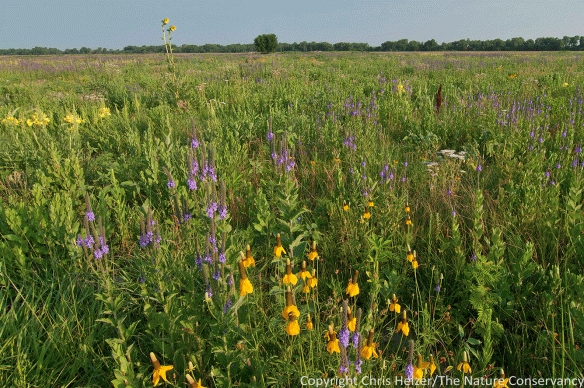
This 2013 photo shows a restored Platte River Prairie recovering from severe drought, fire, and intensive grazing from the previous year. Grasses are weak, but opportunistic forbs are prolific, including many that provide excellent resources for pollinators and lots of seeds for insects and wildlife.
What are we afraid of?
I’m more and more convinced of the importance of putting prairies through periods of stress and recovery, especially when those stresses are applied in a way that provides a shifting mosaic of stressed, recovering, and full strength vegetation patches across a prairie. No matter how hard we have grazed prairies, even during severe and extended drought periods, the plant communities have always bounced back during the recovery periods that follow. In addition, my own observations and data collected by many researchers have documented benefits to wildlife and invertebrates that come from the variety of habitats provided by this kind of management. (You can read more about patch-burn grazing here and the way I manage my family prairie here.)
While I’m confident that it’s valuable to beat prairies up now and then, I’m having a hard time convincing others to try it. Both ranchers and public land managers tend to have strong visceral reactions when I walk them through patches of really intensively grazed prairie. Ranchers are often convinced that I’ve killed the grasses and created weed and erosion problems that will never go away. Conservation area managers worry about potential weed invasions too, and some also wonder if sensitive wildflowers will survive the stress. Many of those land managers also flinch at the lack of habitat structure for wildlife species they care about.
Walking tour participants from an intensively grazed patch into a nearby area of recovering vegetation doesn’t usually help things. Ranchers tend to see the flush of opportunistic plants as validation of their fears about dead grass and weed problems, even when I next show them patches where the grasses have regained dominance after a few years of rest. Some wildlife managers recognize the value of the weedy vegetation as habitat, but worry about the perceptions of neighbors and the public who just see weeds, not habitat. Others see the weedy vegetation as a sign that the plant community has been degraded, despite the fact that the plant species they like better haven’t gone away.
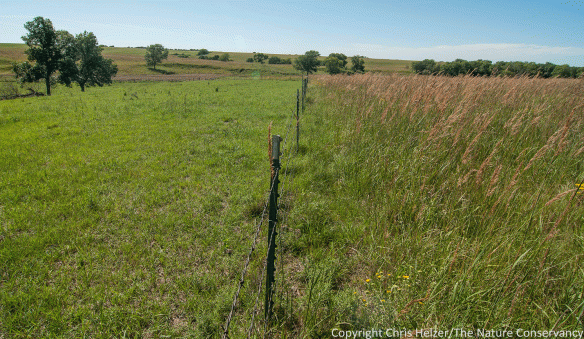
This fenceline photo from our family prairie was taken in September 2014. The pasture on the left had been grazed hard all season (the grass is about 2-3 inches tall), while the one on the right had been mostly rested for more than a year. Besides helping to increase plant diversity, this kind of grazing also creates a variety of habitat conditions across the prairie.
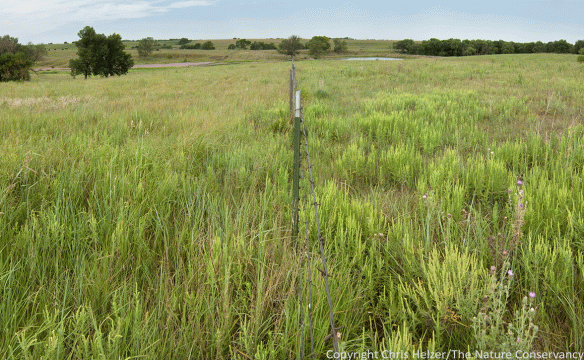
This is the same fenceline as shown above (just slightly uphill) as it looked in mid-August of 2016. The grasses on the left have recovered from the long intensive grazing in 2014 and are ready to be hit hard again next season. The ragweed on the right is enjoying a good year while the competing grasses are recovering from being grazed intensively for most of 2015
To be clear, I’m not suggesting that all prairies would benefit from the kind of periodic intensive grazing I’m talking about here. Some prairies, for example, are simply too small and isolated. There are big logistical challenges associated with fencing and providing livestock water in small prairies. More importantly, there just isn’t space to graze some portions of small prairies while leaving other areas to rest and recover. (Small prairies have a number of other challenges that make any kind of management difficult. If you’re interested, I tried to address some of those in a blog post several years ago.)
I also have a number of lingering questions about how best to apply intensive grazing and recovery periods to prairies. For example, I strongly suspect that the best results come from intensive grazing bouts that last between a couple months and a full growing season. Grazing for only days or weeks doesn’t seem to stress the grasses as much as longer periods of repeated grazing on those plants. In addition, different grass species grow strongly at different times of year. Because of that, grazing for a short time can just shift dominance from the grasses growing strongly during the grazing bout to species that peak in their growth after grazers leave. Since my objective is to really weaken the entire grass community, I don’t think short grazing periods will do the job – but I’d like to test that more.

This is one of our restored Platte River Prairies at the end of August of this year. The grasses were grazed hard all season, and eventually went dormant during a hot dry spell. Many of the forbs were also grazed, but not all of them. This part of the site will likely be very weedy looking next year.
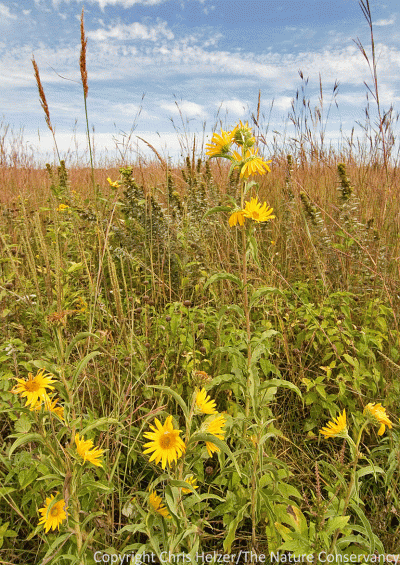
This is the same restored prairie as shown above, but the photo was taken several years ago during a year it wasn’t being grazed. It will look like this again in a few years.
I’d also love to see more data on the responses of various vertebrate and invertebrate populations to intensive grazing, recovery periods, and the overall mix of habitat provided by the kind of management I think is important. There is strong research showing benefits to small mammal and bird communities, and some information on invertebrates, but only some of them. Learning more about the response of reptiles and a wider selection of invertebrates to this kind of grazing management would be really helpful.
In the meantime, however, I’m going to keep beating up my prairies. Not only do I think they can take it, I think the prairie communities I work with thrive best under that kind of management. (I will keep an eye on what happens, however, constantly vigilant for signs that I’ve gone a little too far.) I’ll also keep trying to convince others to stop babying their prairies so much. I’m hoping I can find a few ranchers willing to push pastures a little harder than they usually do – allowing longer rest periods to compensate, of course. That shouldn’t require changing stocking rates, but might provide some really nice benefits for pollinators and wildlife species. I know I’m going to continue to face skepticism from many corners, but I really think this concept needs to be explored further. Prairies have shown their resilience over thousands of years. I think we can trust that kind of track record.
So…who’s with me?


 The Prairie Ecologist