
Capturing Post-Wildfire Recovery Through Timelapse Photography

Last week, I posted that I’d been up at our Niobrara Valley Preserve, helping to set up timelapse cameras to document the recovery of that site from the wildfire last July.  Back in February, photographer Michael Forsberg, Jeff Dale, Rich Walters, and I picked out preliminary locations for nine cameras.  Jeff then built the camera systems, and we got them installed and started up last Tuesday and Wednesday.

Mike and Jeff are part of Moonshell Media, the group we’re contracting with for this project.  You may have seen their work before – most of the Moonshell Media staff are also working on the Platte Basin Timelapse project, which includes video from one of our Platte River wetland restoration projects, along with numerous other stories of water and the Platte River from headwaters to mouth.

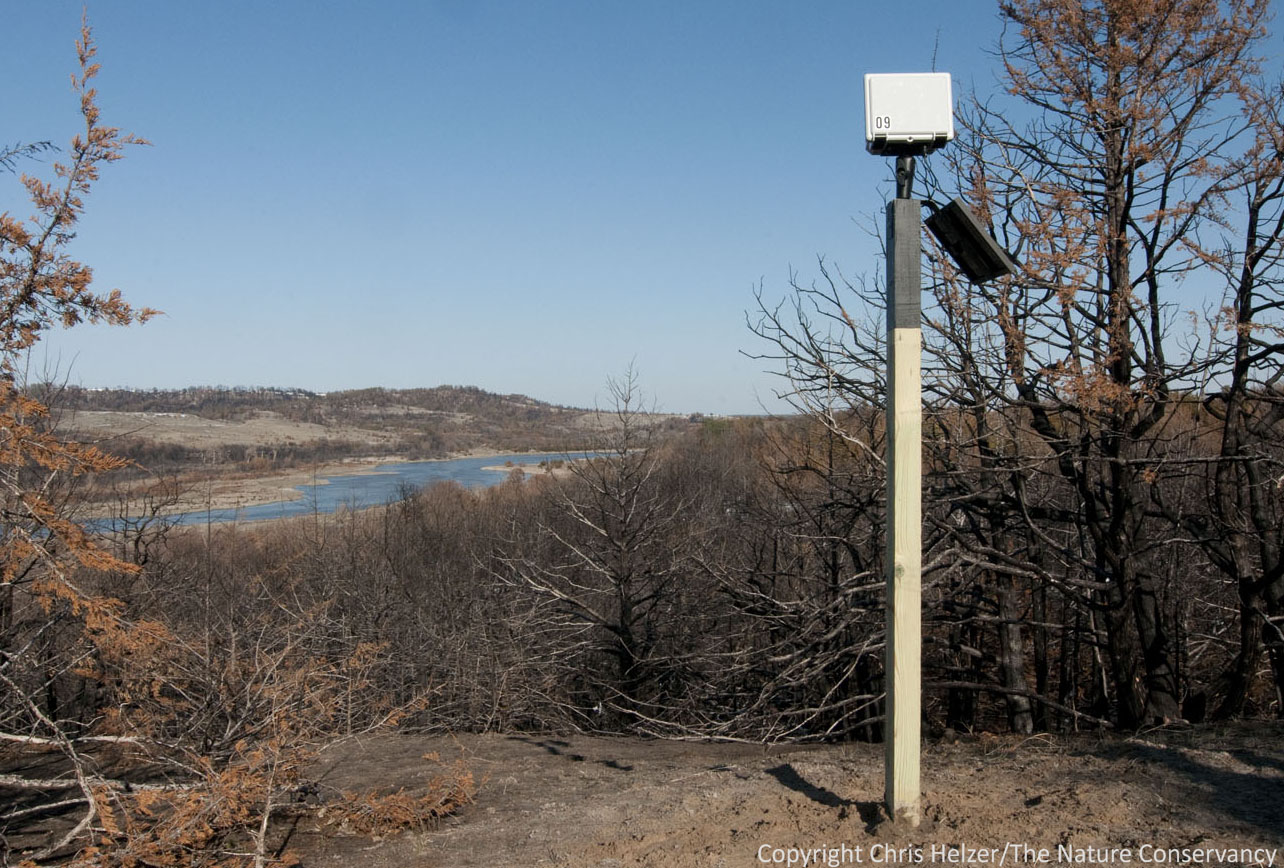
A timelapse camera, taking a photo every daylight hour, will record the change in this landscape view over the next several years.

This timelapse camera will be taking a photo every daylight hour for the next several years, recording the recovery of this landscape from the Fairfield Creek wildfire in July 2012.

The timelapse project at the Niobrara Valley Preserve is being funded by the Nebraska Environmental Trust, as part of a larger project to study the aftermath of the wildfire and generate information to help reduce negative impacts from similar events in the future.  Eacn of our nine cameras will be taking one photo every hour, during daylight hours, for at least several years.  An additional camera will be a mobile unit that we’ll move from location to location to document short-term changes or events.  The cameras will help us tell the overall story of wildfire recovery, but will also link with and help illustrate the results of several research projects happening in the same places.

Here are some photos of the installation last week, along with descriptions of what some of the cameras will be documenting.  I will, of course, let you know when/where videos from the project can be viewed when its time.

Jeff Dale fastens a camera mount near the top of a windmill tower.

Jeff Dale fastens a camera mount near the top of a windmill tower.

.

The "windmill cam" will capture a wide view of bison-grazed sandhill prairie as it greens up this spring, but will also follow it over the next several years, as dynamic patterns of bison grazing, weather, and prescribed fires shape its habitat structure and species composition.

The “windmill cam” will capture a wide view of bison-grazed sandhill prairie as it greens up this spring, and then will follow it over the next several years, as dynamic patterns of bison grazing, weather, and prescribed fires shape its habitat structure and species composition.

.
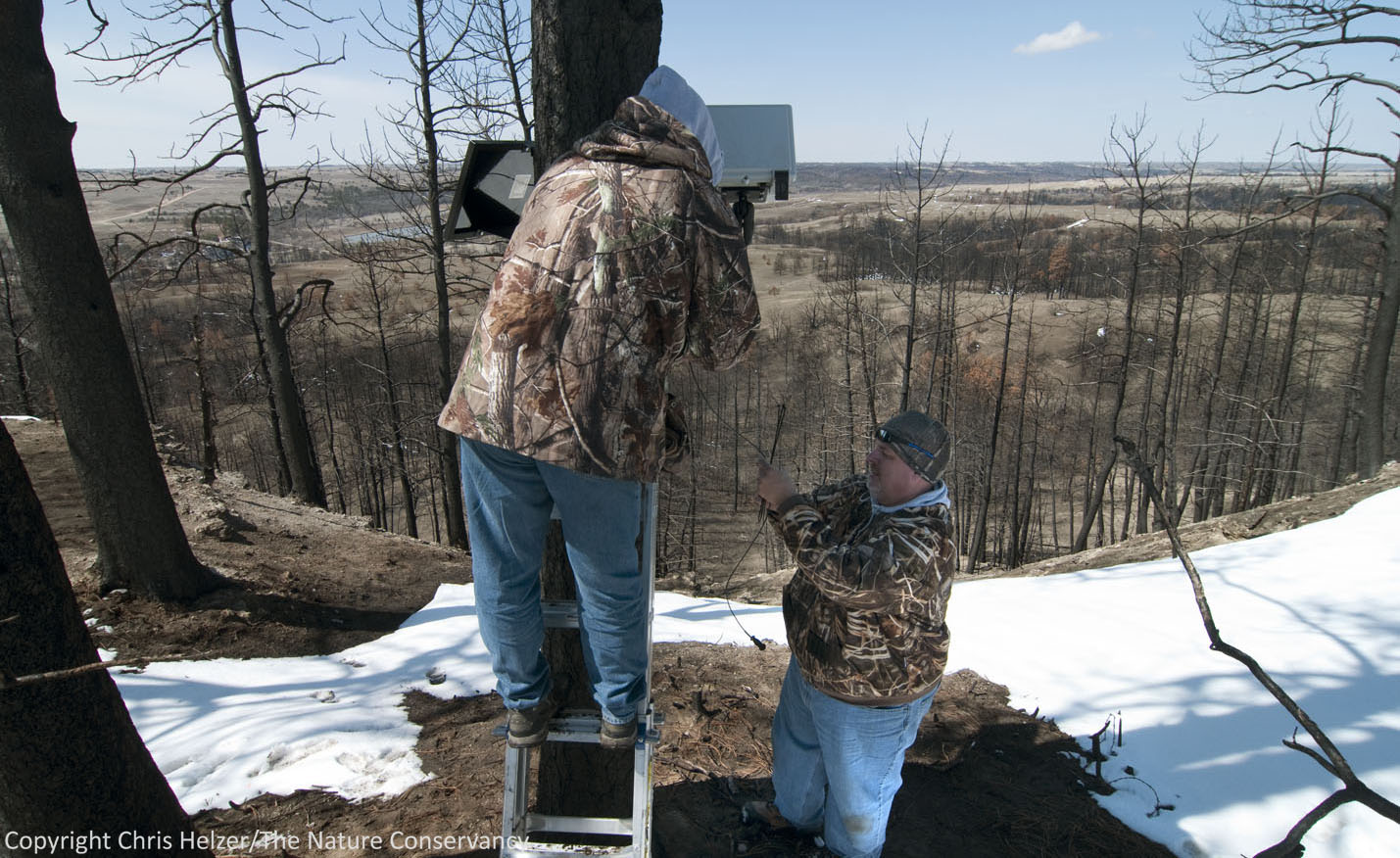
Jeff Dale and David Weber install a camera that will look straight down a steep slope in the burned pine woodland on the ridge north of the river.  Among other things, this camera will help capture evidence of any soil erosion that occurs over time.

Jeff Dale and David Weber install a camera that will look straight down a steep slope on the ridge north of the river. Among other things, this camera will help capture evidence of any soil erosion that occurs over time under the burned ponderosa pine woodland.

.
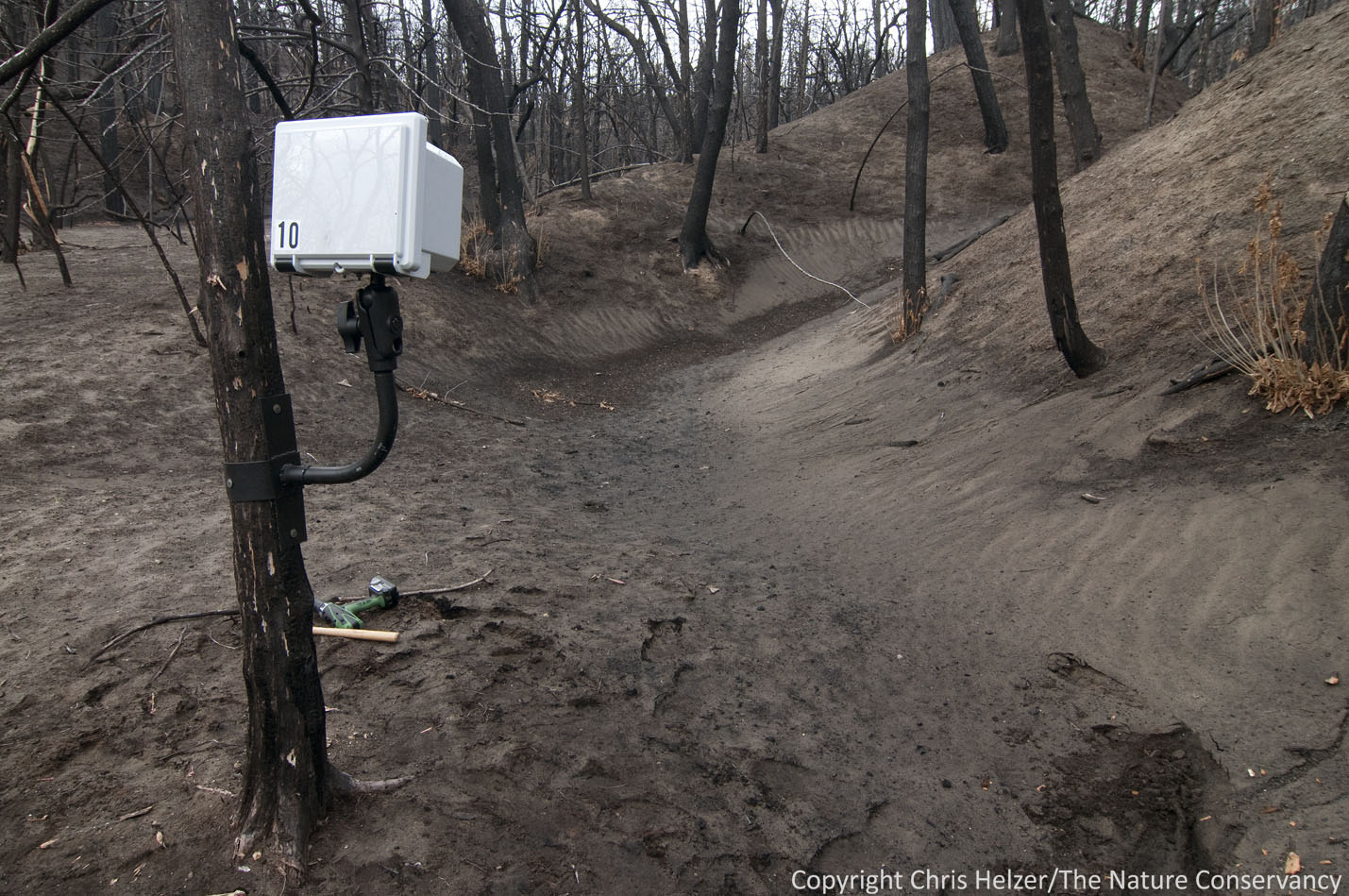
This camera is set up to record any sediment that pools up at the base of the (formerly) pine-covered ridge north of the river.  In addition, it will record the resprouting of several oak trees growing within the frame.

This camera is set up to record any sediment that pools up at the base of the (formerly) pine-covered ridge. In addition, it will record the resprouting of several oak trees growing within the frame.

.

This camera was installed on a new fenceline - moved after the initial fence was destroyed by fire.  The new fenceline moves the south end of the bison pasture into what was formerly cattle pasture.  This camera will record differences in the recovery of prairie grazed year-round by bison (left) vs. prairie grazed by cattle.  One of many differences we expect to see is that yucca will likely disappear on the left side of the fence due to year-round grazing by bison.  Winter grazing (by either cattle OR bison) suppresses yucca, which is rarely grazed at all during the summer.

This camera was installed on a new fenceline – rebuilt in a new location after the initial fence was destroyed by fire. The new fence location expands the south end of the bison pasture into what was formerly cattle pasture. The camera will record differences in the recovery of prairie grazed year-round by bison (left) vs. prairie grazed only periodically by cattle. One of many differences we expect to see is that yucca will largely disappear in the bison pasture. Winter grazing (by either cattle OR bison) suppresses yucca, which is rarely grazed at all during the summer.

.
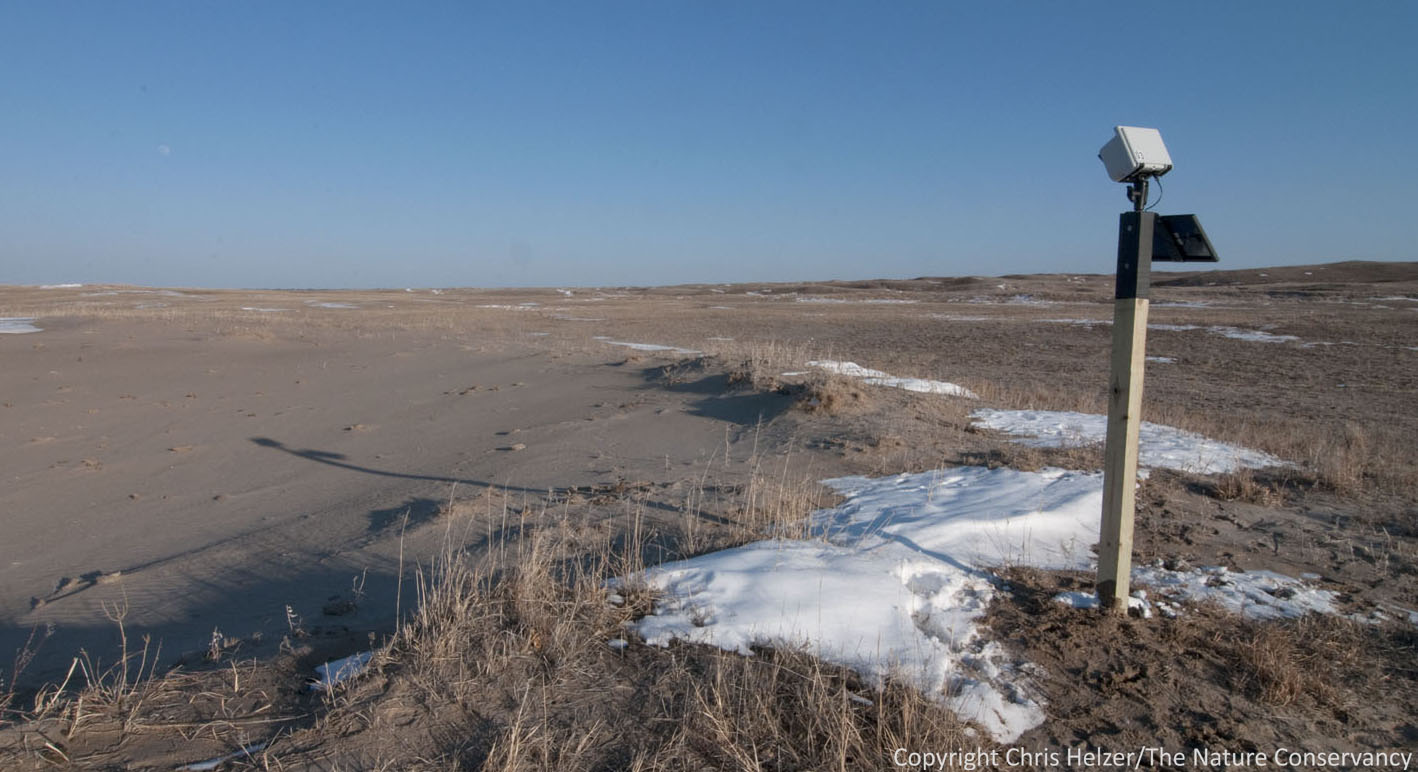
How fast will this sandhills blowout carve away recently-burned sand prairie?  Our camera will help us find out.  Based on previous experience with summer fires, we don't expect to see any significant increase in wind erosion, but this camera (combined with aerial photograph, and perhaps on-the-ground measurements) will allow us to test that assumption.

How fast will this sandhills blowout carve away recently-burned sand prairie? Our camera will help us find out. Based on previous experience with summer fires, we don’t expect to see any significant increase in wind erosion, but this camera (combined with aerial photographs, and perhaps on-the-ground measurements) will allow us to test that assumption.

.
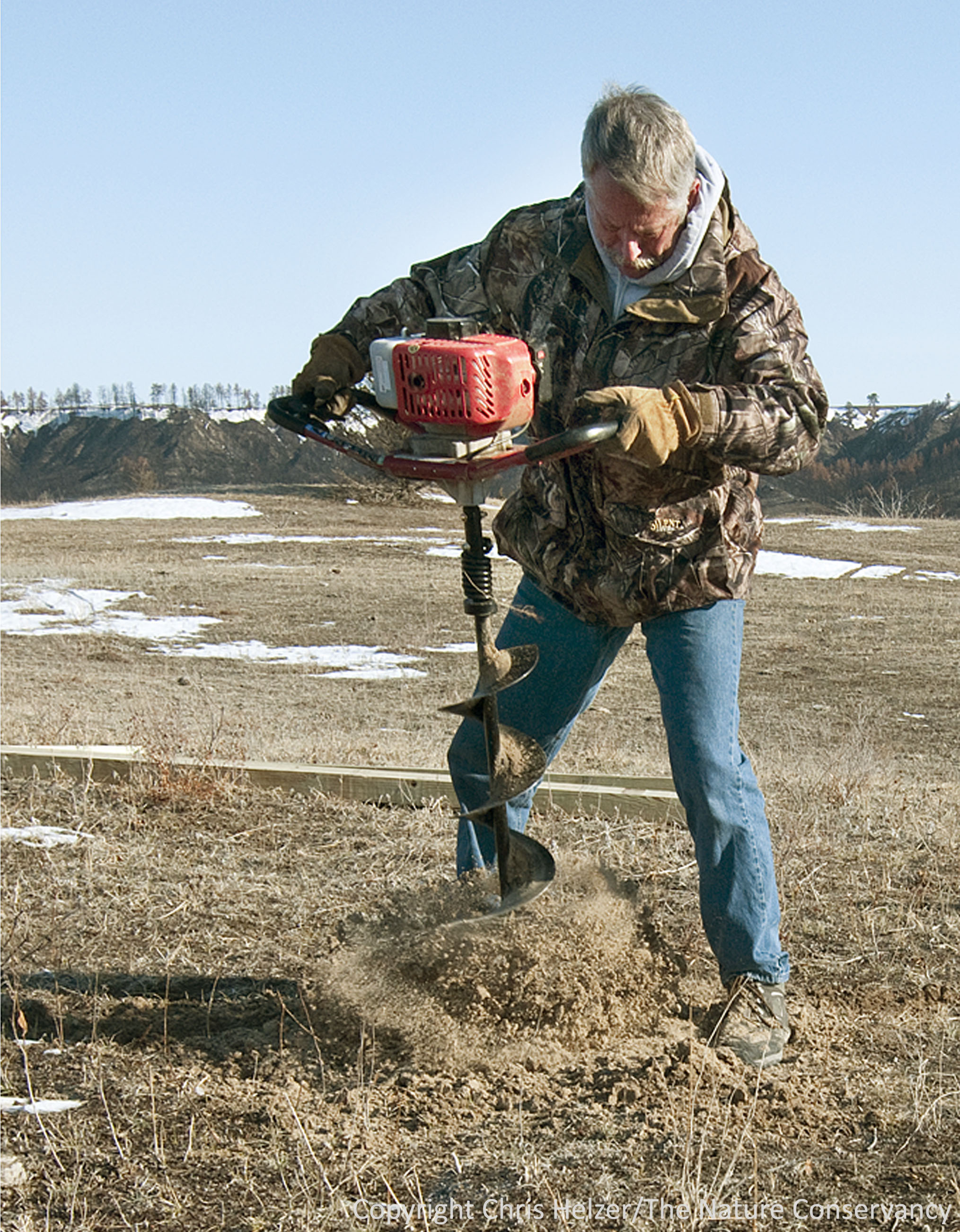
Jeff digs a hole for the camera I'm most excited about.  This camera will focus on a 8x10 foot rectangle of bison-grazed prairie, looking straight down on it from above.  Over the next several years, we should be able to watch the plant community recover from the fire, but we'll also see yearly differences in which species bloom, and when, in response to weather, grazing, future fires, etc.  We can also record any long-term changes in the plant composition within this area.

Jeff digs a post hole for the camera I’m most excited about. This camera will focus on a 8×10 foot rectangle of bison-grazed prairie, looking straight down on it from above. Over the next several years, we should be able to watch the plant community recover from the fire, but we’ll also see yearly differences in which species bloom, when they bloom, and how they respond to weather, grazing, future fires, etc. We can also record any long-term changes in the plant composition within this area.

.
We want to see how the plant community will recover in areas formerly underneath dense cedar now that those cedars are dead.  We expect lots of weeds, but hope not to see many truly invasive plants.

We want to see how the plant community will recover underneath dense cedar trees now that those cedars are dead. We expect lots of weeds, but hope not to see many truly invasive plants.

.

Jeff, the technical wizard who designed most of the equipment that makes the cameras work right, explains how they work.  I got some of it, I think...

Jeff, the technical wizard who designed most of the timelapse camera systems, explains how to adjust them and keep them working.  I followed some of it, I think…

A Dandy Little Predator

I took my boys to our family’s prairie today.  I was only intending to stay for a little while, but they were having so much fun building forts in the trees and drawing pictures in the mud, we stayed for several hours.  Since they were entertaining themselves, I took a walk to see what was blooming.

Because of the late spring, I only found three wildflower species in bloom.  Ground plum (aka buffalo pea or Astragalus crassicarpus) was going strong, and there were a few pussy toes (Antennaria neglecta) getting started.  But the most abundant flower was the good ol’ dandelion.  While the non-native yard weed is disliked by many people, it was certainly popular with many bees and flies who didn’t have many other options for pollen and nectar sources today.

A sweat bee enjoying a pollen-loaded dandelion at the Helzer prairie south of Aurora, Nebraska.

A sweat bee enjoying a pollen-loaded dandelion at the Helzer prairie south of Aurora, Nebraska.  It’s ALMOST sharp enough to be  a good photo.

I tried a few times to photograph bees and flies visiting dandelions, but most were too wary to let me get very close.  The light was pretty harsh anyway, and the bees certainly weren’t going to let me pull out my diffuser (2 ft diameter thin-cloth-covered circle) before they zipped away.  I did finally manage to find one bee so focused on pollen that I got one nearly decent photo before it noticed me.  Most of the time, however, the pollinators left before I got anywhere close.

As I approached one flower, the small bee on it flew away, but I noticed something else still on the flower.  When I got close enough, I realized it was a spider – apparently hoping to make a meal of the bee I’d inadvertently chased away.  While I felt a little bad about that, I thought maybe the spider would make a more accomodating photo subject, so I got out my diffuser and tripod to see what I could do.  The spider scooted off the top of the dandelion flower when I got close, but it only retreated as far as the stem of the flower, so I did get a few shots of it there.

A spider on a dandelion flower stem.  Moments before it had been stalking a small bee on top of the flower, but a clumsy photographer scared the bee away.

A spider on a dandelion flower stem. Moments before it had been stalking a small bee on top of the flower, but a clumsy photographer scared the bee away.

The spider then (very quickly) scuttled a few inches away from the flower and stopped again.  If I hadn’t seen it move, it would have disappeared completely against the background of the identically-colored prairie thatch.  Beautiful camouflage!

The same spider as above, showing off it's perfect camouflaged coloring against the grass litter.

The same spider as above, showing off it’s perfect camouflage coloring against the grass litter.

I sure wish I’d gotten to see the spider try for that bee.  I’m not sure what kind of spider it was, but it certainly wasn’t a crab spider, which is what I typically see hunting on flowers.  This one looked more like an active hunting spider (similar to a wolf spider) than a nearly blind ambush spider  (such as a crab spider).  I’m guessing prey isn’t overly abundant at this time of year, and its probably hard to turn down an opportunity to hunt in one of the few places you’re pretty sure to find it.

Dandelions might not be everyone’s favorite flower, but I’m sure glad to have them in my prairie in the early spring.  Apparently, so are quite a few bees and flies – and at least one enterprising spider!